
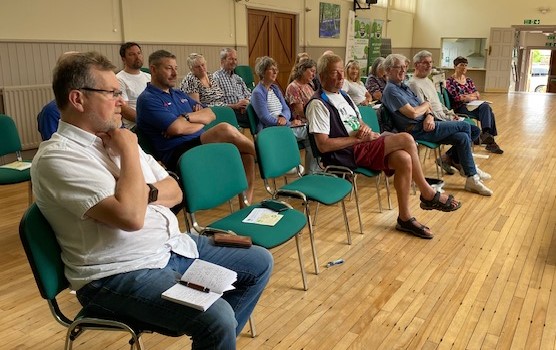
Brian Watson from Community Action Northumberland began by providing an overview of how the renewable energy situation is changing. Globally the generation of power through gas and coal no longer makes financial sense, and huge investment is going into renewables with the cost of renewable energy falling rapidly. However, this reduction is not currently passed onto the consumer because of the way in which the energy market works. In addition the oil and gas sectors have a lot of assets and are keen to avoid these becoming ‘stranded’. They are lobbying hard for solutions that will retain elements of them. However in Brian’s view, whilst there is a lot of talk about hydrogen, this is unlikely to be a widespread domestic solution, as is HVO.
There are also issues about whether the UK grid is ready for renewables and whether there is capacity to add new connections as they are needed. There is a strong need for increased battery storage, a ‘smarter’ grid and to develop nuclear energy as part of the mix.
But there are lots of positive steps taking place – e.g a 15 GW wind farm in the North Sea, a six fold increase in large renewable planning applications, and the strong possibility of a cable bringing wind and solar power from Morocco to the UK.
The government is focussed on improving house EPC ratings and this is a good place for householders to start. In Swarland, many homes are rated D or below. In general the most effective way of improving the rating is to improve insulation and install solar panels. In the rental sector, all properties will be required to have an EPC rating of C by 2028.
In Europe, air source heat pumps are much more common – partly because houses are in general better insulated. Homeowners considering installing a heat pump should be aware of the lifespan of heat pumps and the need for maintenance – although it is a myth that existing radiators and pipes will need to be replaced – a full assessment would be required to determine what’s necessary.
At the local level, Brian’s post has been created to provide independent, individual advice to off-gas grid households. This include advising on a range of options based on what people are trying to achieve, taking into account the expenditure and potential payback time. Brian also spoke about the work that NCC are doing, including a number of district heat networks and the Warmer Homes grant. The conditions for access to the grant are based on household income and EPC rating.
Finally, there is interest across the country in community energy schemes. One in Norham made good progress, but in the end was unable to obtain a connection to the grid to enable it to move forward.
Three local householders then gave short presentations about their experience of installing renewable energy. Lesley talked about solar panels and battery storage, Alex about putting renewable technology into a self-build house and Barry spoke about the challenges of putting new technologies into an old farmhouse. They explained that new technology is able to run systems in the most effective way – prioritising demand, storage and supply back to the grid.
All three speakers emphasised the importance of research, using Trustmark rated suppliers and others who have already installed the technology. The overarching message from all three was how effective and reliable renewable energy is – and that if you are able to do it – it’s the right thing to do.
Finally, the idea of having an ‘Open House’ event was suggested, where people can book to visit local householders to see the technology in action and ask more questions. SNAC will look at how we can take this forward.
 snac.online